
Avionics & Airframe Bench Calibration Trials
Optimizing Thrust Dynamics and Dual-IMU Vibration Isolation

Vibration: The Enemy of Visual-Inertial Odometry
High-KV brushless motors operating at 20,000 RPM generate acoustic and physical harmonic frequencies that can cause gyroscope saturation in companion IMUs. During our early trial flights, visual odometry drift accumulated up to 15 centimeters over a two-minute hover.
To resolve this, our embedded avionics team engineered custom silicone vibration dampers and decoupled the companion compute power rail with low-ESR capacitors and isolated BEC regulators.
Dynamometer Testing
On the propulsion test stand, each T-Motor F40 Pro IV was tested across 0% to 100% throttle sweeps. Real-time thrust, current draw, and temperature data confirmed a 4:1 thrust-to-weight ratio while maintaining thermal stability under continuous hover loads.
EVENT PHOTOGRAPHS & FIELD NOTES
Avionics PCB wiring and sensor integration
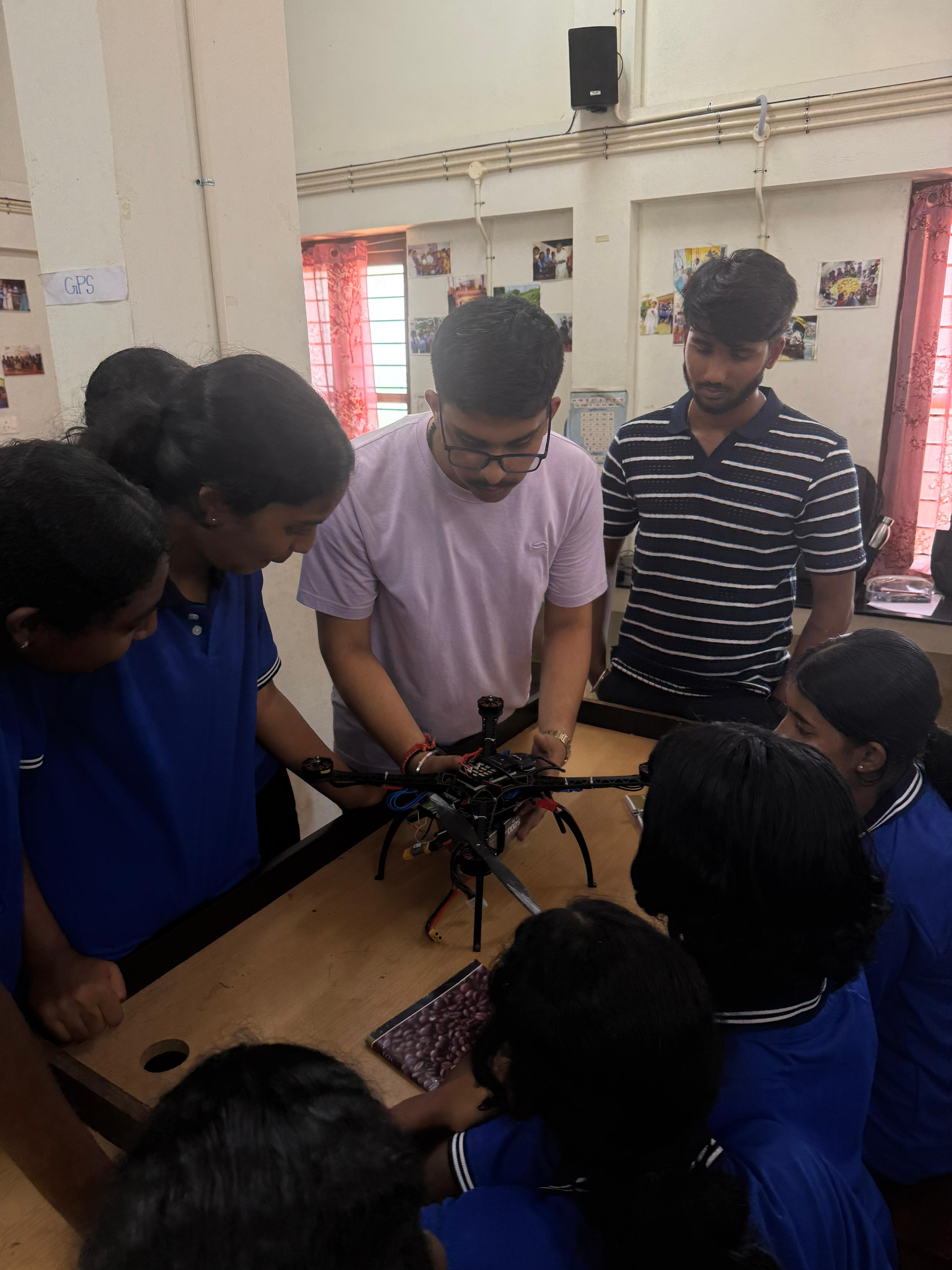
Airframe mechanical alignment and propeller balancing
- ✦Vibration noise reduced by 72% across all 3 spatial axes
- ✦Verified 4:1 thrust-to-weight ratio with 1850g all-up weight
- ✦Stable 20-minute bench run with zero optical odometry drift
Autonomous aerial robotics and unmanned systems research at the Indian Institute of Space Science and Technology.